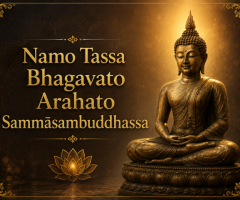
“Namo Thassa Bhagavato Arahato Samma Sambuddhassa” is a sacred Pali invocation traditionally recited in Theravada Buddhism as an expression of reverence and homage to the Buddha.
The phrase honors the Buddha as the Blessed One, the Worthy One, and the Perfectly Self-Awakened One—a teacher who discovered the path to liberation through his own profound understanding and shared it with others.
Rather than worshipping Buddha as a deity, the recitation recognizes his wisdom, purity, compassion, and complete awakening. It reminds practitioners to cultivate mindfulness, humility, compassion, ethical conduct, and understanding in their own lives.
Namo Thassa is commonly chanted before meditation, during Buddhist ceremonies, and as part of daily devotional practice. Repetition can help calm the mind, establish a respectful and focused state of awareness, and inspire practitioners to follow the path toward greater wisdom and inner peace.
In essence, Namo Thassa is a simple expression of respect for the Buddha and a reminder of the possibility of awakening through sincere practice and understanding.
Namo Tassa
Namo expresses reverence, respect, or homage.
Tassa means “to Him”, referring to the Buddha.
Together, Namo Tassa conveys the meaning: “Homage to Him.”
Bhagavato
Bhagavato comes from Bhagavant, meaning “the Blessed One” or “the Exalted One.” It is another respectful title referring to the Buddha.
Thus, Bhagavato means “to the Blessed One.”
Arahato
Arahato refers to an Arahant, commonly translated as “the Worthy One.” An Arahant is one who has completely overcome greed, hatred, and delusion—the fundamental causes of suffering and continued rebirth.
The Buddha himself was an Arahant, having fully purified his mind and attained liberation. In this invocation, Arahato specifically refers to the Buddha as the Worthy One.
Sammāsambuddhassa
Sammāsambuddhassa refers to the “Perfectly Self-Awakened One.” It describes the Buddha as one who discovered and realized the truth through his own profound insight, without being taught the path by another Buddha.
The term distinguishes a Sammāsambuddha from an ordinary Arahant: while both attain liberation, a Buddha independently discovers the path and then teaches it to others.
Overall Meaning
“Namo Tassa Bhagavato Arahato Sammāsambuddhassa” can therefore be understood as:
“Homage to Him, the Blessed One, the Worthy One, the Perfectly Self-Awakened Buddha.”